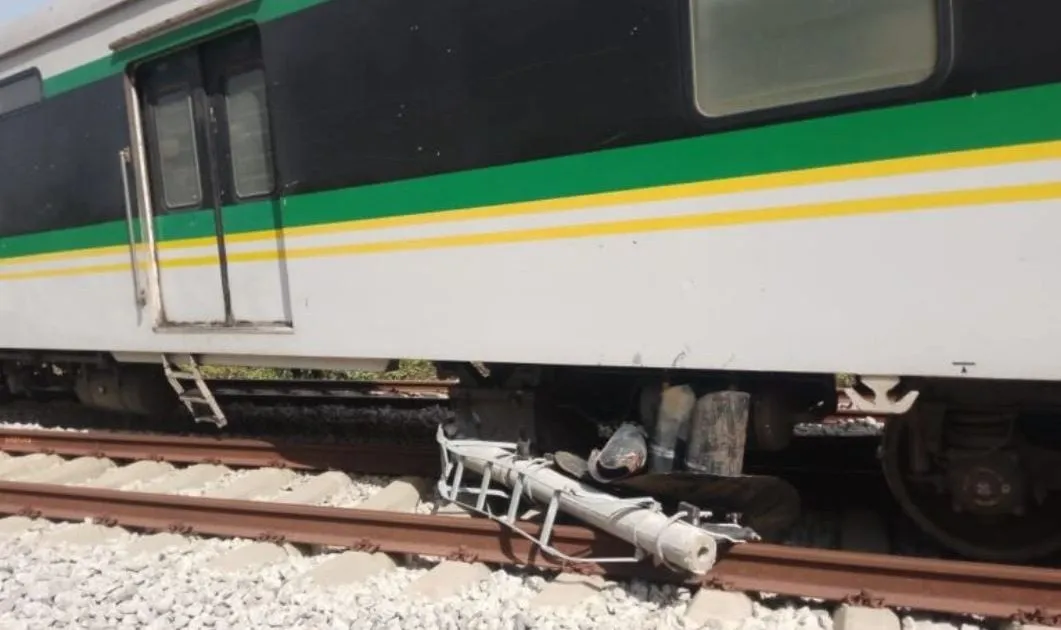
A train operating on the Abuja-Kaduna rail corridor derailed on March 16, 2026, injuring several passengers. The train was traveling from Kaduna to Abuja when it reportedly collided with another train along the corridor, leading to a chaotic scene.
Passengers described the moment of the incident, with one, Sada Malumfashi, stating, “Just dropped from the Kaduna-Abuja train. We heard a loud bang, and the train jolted to a stop, flinging people across.” The train remained stationary for about 30 minutes before resuming its journey.
Emergency response procedures were activated immediately after the incident, and the injured passengers were taken back to Idu train station for medical attention. Fortunately, no fatalities were reported as a result of the incident.
Kayode Opeifa, managing director of the Nigerian Railway Corporation (NRC), confirmed the incident, stating, “It is confirmed that our Abuja-Kaduna train had an incident at Asham. Passengers were injured while an investigation is ongoing into the exact cause of the incident.” Opeifa also noted that the train remained on the track and was able to proceed to Idu Station, where passengers safely disembarked.
However, some passengers expressed frustration over the lack of communication from the NRC. Malumfashi added, “Passengers got hit, and most are bleeding and severely injured. Train delayed for some 30 minutes and resumed to Kubwa. No communication from @info_NRC on anything.”
The NRC is conducting an investigation to ascertain the cause of the incident, with initial reports suggesting a coupling issue may have contributed to the derailment. Opeifa described the incident as avoidable.
The Abuja-Kaduna rail corridor is a busy rail line linking the Federal Capital Territory with Kaduna State, serving as a vital transportation route for many commuters.
Details remain unconfirmed as the investigation continues, and observers are awaiting further updates from the NRC regarding the safety measures that will be implemented to prevent future incidents.